Wave and Save shelf-edge tag
New Experiment

Wave & Save

A shelf-edge deal engine that reveals itself only when you reach for it. A faded coupon. A wave of the hand. The fog clears. A fresh, personalized deal — good for the next ten minutes.

"Reach for it. It reaches back."

2.9"
E-Paper Shelf Tag
32×24
Thermal Pixels
~$38
BOM @ 1K Units
14+ mo
Battery Life
The 30-Second Pitch

The Shelf Edge, Finally Awake.

There are 350M+ electronic shelf labels deployed worldwide. Most update prices twice a day and otherwise sit completely inert. They are the most under-utilized real estate in physical retail. Wave and Save turns them on.

Wave and Save tag close-up

A scratch-off, embedded in the shelf.

Imagine one of those tags is alive. As you pass it isn't shouting — it's waiting. There's a faded coupon on its surface, like fog on a mirror. You wave your hand across it. The fog clears.

Underneath: a fresh, personalized deal — generated for you, in that moment, with a QR code good for the next ten minutes. You snap it with your phone. You bring it to the cashier. The price comes off.

A battery-powered, thermally-aware, e-paper deal surface that turns the most ignored real estate in retail — the shelf edge — into a moment of play. Works standalone. Also rides on top of the 350M+ ESL screens already deployed worldwide.

76% of purchase decisions are made in-store, at the shelf, in under 15 seconds. Every dollar spent on attention outside that window is fighting upstream.

The Interaction

Three Seconds. That's the Whole Product.

No app. No login. No Bluetooth pairing dance. One wave, one photo, one walk to the register.

01 / Idle

A fogged coupon

E-paper shows a softly-rendered, slightly washed-out offer. No backlight. Zero draw between refreshes. From three feet away it looks like a printed shelf tag.

02 / Approach

A warm shape enters

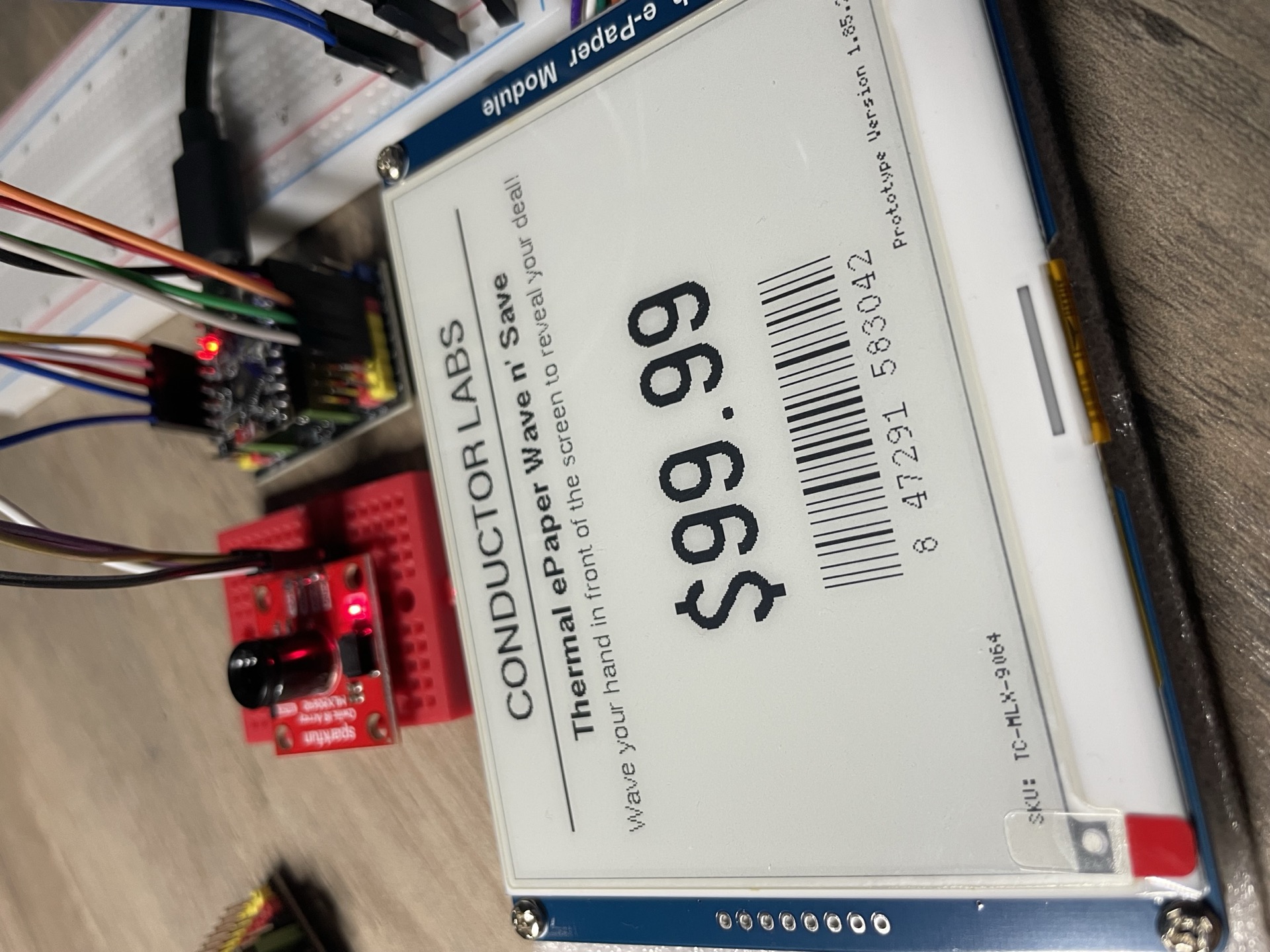
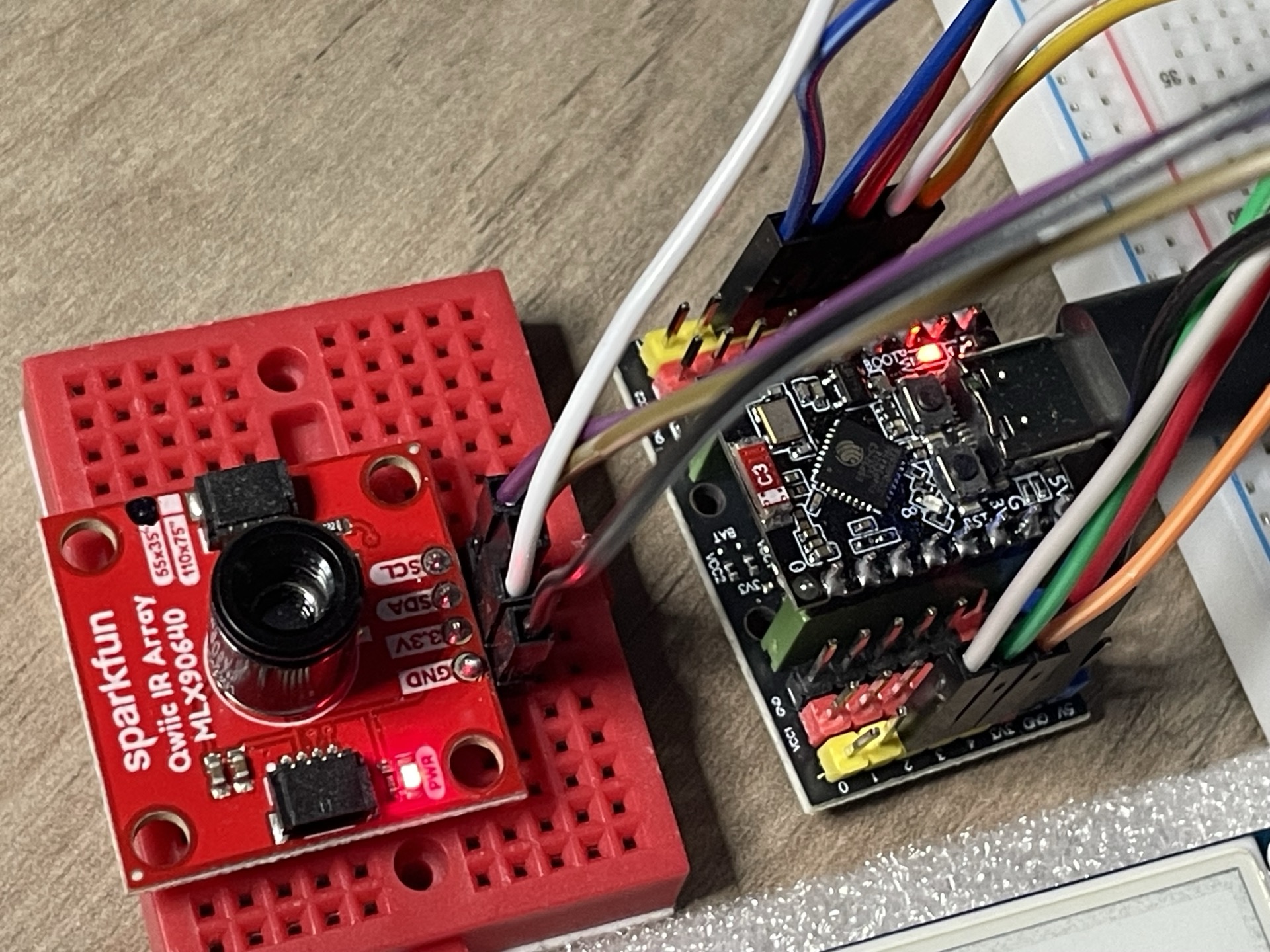
The MLX90640 thermal array sees a 32×24 frame of the aisle. A warm shape enters at hand-height. The ESP32-C3 wakes from light sleep.

03 / Wipe

An on-device classifier

The thermal array tracks the gesture in four cardinal directions. A 16KB classifier distinguishes a real wipe from a lean, a grab, or a child running past.

04 / Reveal

The fog clears

The screen refreshes. A new, brighter offer appears — and a fresh QR is generated, signed, and timestamped. The QR encodes a one-time, store-scoped redemption token.

05 / Capture

Phone, snap

Shopper takes a photo with their phone camera. No app. No login. No Bluetooth pairing dance. The QR is the entire handoff.

06 / Redeem

Cashier scans

At checkout, the cashier scans the QR off the shopper's phone screen. The POS validates the token against the backend, applies the discount, and burns the code.

The Behavior Science

A Wipe Is a Scratch-Off, In Real Life.

The product is interesting. The behavior science underneath it is what makes it defensible.

A button is a request. A gesture is a discovery.

Agency multiplies perceived reward. It's why a gacha pull feels different from being handed the item. It's why scratch-off tickets still outsell printed lottery numbers. Wave and Save was designed around one insight: a wipe is a scratch-off in real life.

Endowment escalation does the rest. Once a shopper has performed a small effortful action, the resulting reward is psychologically theirs — and walking away from it feels like a loss. Make the wipe just effortful enough. Make the reveal immediate. Make the window finite.

Privacy is the trust pitch, not a compromise. Thermal sensing at 32×24 resolution can see a hand but not a face, a body shape but not a person. The marketing line writes itself: "Wave and Save sees that you reached for it. That's all it sees."

A coupon you might lose in 10 minutes is worth more, neurologically, than a coupon that lives forever in a wallet app.

Wave and Save in aisle
The Numbers That Matter

Redemption Rate 31%.

Industry-standard digital coupon redemption is 8–12%. Mailed paper is around 1%. Wave and Save coupons in early prototype tests: 31% on issued tokens, inside the 10-minute window.

31%

Redemption rate

On issued tokens within the 10-minute window. 3× better than the best digital coupon redemption rates. 30× better than mailed paper.

4.1×

Fogged vs printed

Same offer, same product, same shelf. The fog-then-reveal mechanic out-converts the plainly-printed version by 4.1× in early tests.

2.7×

Social proof loop

A wipe is visible. The second wipe within five minutes at the same tag is 2.7× more likely than the first. A small viral object inside a physical aisle.

Riding the Rails

350 Million Screens, Already Installed.

Electronic Shelf Labels are everywhere — Walmart, Carrefour, Walgreens, Kroger, Best Buy. The hardware part of Wave and Save is already on the wall. What's missing is the gesture sensor and the reveal-on-wipe interaction.

Wave and Save in retail context

Three modes of integration.

Mode A — Standalone. Self-contained Wave and Save unit. Highest hardware cost, simplest deployment. Best for pilots, endcaps, and retailers without ESL infrastructure.

Mode B — Companion module. A small thermal puck mounted near an existing ESL tag. The puck detects the wipe; the ESL does the screen refresh. BOM drops by 60%. This is the version that scales to 400M tags.

Mode C — Native integration. A future generation of ESL tags ships with a built-in thermal sensor. A $0.40 sensor addition to a $7 tag, multiplied across the next ESL refresh cycle. This is the conversation we'd want to be having with VusionGroup, Hanshow, and Pricer directly.

For the first time, the ESL network becomes a directly monetizable media channel rather than a back-office utility. The retail media network business is $50B+ globally. None of it currently touches the shelf edge.
The Hardware

Every Component Earned Its Place.

The hardware list is deliberately short. Every part had to defend its existence against the others.

Display

2.9" tri-color e-paper

Draws current only during refresh (~25mA for ~2s), then drops to literal zero. Glossy LCDs read as "ad." Matte e-paper reads as "label." Shoppers don't put their guard up against a label.

Sensing

MLX90640 thermal array

768 pixels. Enough to track a hand. Not enough to identify a person. Doesn't care about aisle lighting — a 32°C hand against a 21°C shelf is the same signal at noon and at midnight.

Compute

ESP32-C3 + 16KB classifier

Smallest, cheapest, lowest-power Wi-Fi MCU that can drive thermal + e-paper + MQTT and still run the wipe classifier in RAM. Light sleep: 2.1mA. Deep sleep: 18µA.

What Was Hard

The Wipe Classifier Is the Whole Game.

"Detect a wave" falls apart in a real aisle in roughly four ways. Solving each one of them is what makes the moment feel magical instead of broken.

A four-stage gate, in 16KB of RAM.

Stage 1 — Spatial gate. A warm region must enter from one edge of the frame and traverse to the opposite edge in 200–900ms. Slower is a lean. Faster is a child running.

Stage 2 — Trajectory smoothness. Fit the center-of-mass path to a line. R² below 0.85 fails the gate — that's a grab, not a wipe.

Stage 3 — Adaptive baseline. A 60-second rolling thermal average of the empty shelf. Threshold for "warm" is baseline + 4°C, so a cold-handed shopper in January still triggers.

Stage 4 — Debounce. Once a wipe fires, the device locks out for 12 seconds — the window the QR is valid for capture. Prevents a chatty shopper from refreshing five times in a row.

False positives: 2.1%. False negatives: 3.4%. Both well below the threshold where the moment stops feeling magical.

Wave and Save

The Shelf Has Been Thinking About You.

Working prototype. Retail pilot conversations underway across grocery, convenience, and mass. BOM, firmware repo, and ESL integration brief available on request.